

Introduction
What is IEPF? The Investor Education and Protection Fund (IEPF) is a fund set up by the Central Government under Section 125 of the Companies Act, 2013. It is administered by the IEPF Authority under the Ministry of Corporate Affairs. Unclaimed dividends, matured deposits and shares whose dividend stayed unclaimed for 7 consecutive years are transferred to it, but they still belong to you, and you can claim them back by filing Form IEPF-5 at iepf.gov.in.
Quick Facts Here is what is IEPF at a glance
| Point | Detail |
|---|---|
| Full form | Investor Education and Protection Fund |
| Set up under | Section 125, Companies Act, 2013 |
| Run by | IEPF Authority (Ministry of Corporate Affairs) |
| What goes in | Unclaimed dividends, shares, matured deposits and debentures, and more |
| Claim form | Form IEPF-5 (online) |
| Official website | iepf.gov.in |
In simple words, IEPF acts as a secure vault for unclaimed financial assets, ensuring that no company can misuse investor funds. Investors or their legal heirs can reclaim these amounts by filing an official application through the IEPF claim process.
What Is IEPF and Why Was It Created?
IEPF exists to protect investors and promote investor awareness. Money and shares that investors fail to claim should not stay stuck with companies indefinitely. Instead they are held in a central fund, and the rightful owner or legal heirs can still claim them.
- Loss of investor wealth
- Mismanagement of funds
- Difficulty for families to recover old investments
- Lack of awareness about unclaimed shares
To address these issues, the IEPF Authority was established.
What gets transferred to IEPF?
Under Section 125 of the Companies Act, 2013, the amounts credited to the Fund include:
- Unpaid or unclaimed dividends (after the prescribed period)
- Shares on which dividend has not been paid or claimed for 7 consecutive years
- Application money received for securities and due for refund
- Matured deposits and matured debentures
- Interest accrued on the amounts above
- Other amounts listed in Section 125(2)
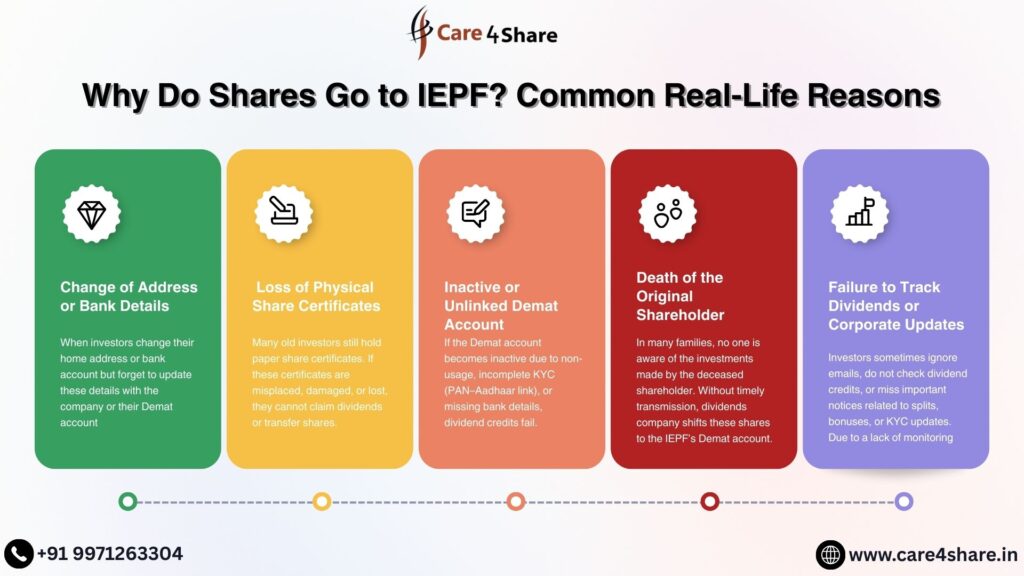
Why do money and shares end up in IEPF?
- Dividends were never claimed, or went to an old or closed bank account
- Address, bank or KYC details were not updated with the company
- Physical share certificates were lost or never converted to demat
- The shareholder passed away and legal heirs never claimed the holding
- Company notices were missed or ignored
How to check whether your money or shares are in IEPF
- Look at the “Unclaimed Dividend / IEPF” section on the company’s website, where the lists are published.
- Search for your details on the IEPF Authority website (iepf.gov.in).
- Contact the company’s Registrar and Transfer Agent (RTA) with your folio number or DP ID and Client ID.
4. Why Do Shares Go to IEPF? Common Real-Life Reasons
How to claim from IEPF
- Confirm the transfer and the years of unclaimed dividend.
- Get the Entitlement Letter from the company or RTA, if the company requires it.
- File Form IEPF-5 online at iepf.gov.in. PAN is mandatory.
- Send the physical documents to the company’s Nodal Officer (IEPF) in an envelope marked “Claim for refund from IEPF Authority.”
- The company verifies the claim and submits its report to the IEPF Authority within 30 days.
- The IEPF Authority processes the claim and credits shares to your demat account and money to your bank account.
For full details, read our guide on [unclaimed shares after 7 years]
Documents usually required
The exact list depends on the company and your case, so check the IEPF-5 help-kit and the company’s procedure. Generally:
- PAN and Aadhaar, plus address proof
- Demat details (client master list) and cancelled cheque
- Copy of share certificate, if shares were physical
- Original indemnity bond and IEPF-5 acknowledgement
- Entitlement Letter, where applicable
For legal heirs: death certificate and succession proof such as a succession certificate, probate or legal heir documents.
Common reasons claims get delayed
Across IEPF claims, delays commonly come from name or signature mismatches, wrong folio or DP ID, incomplete legal heir papers and incorrectly executed indemnity bonds.
How to stop your money going to IEPF
- Keep address, phone and bank details updated with companies and RTAs
- Convert physical shares to demat
- Add a nominee on every holding
- Check your holdings and dividend credits once a year
How Care4Share can help
Care4Share helps with If you are still unsure what is IEPF or whether your shares are affected, Care4Share can check your holdings and guide you through the claim. [IEPF share recovery], [transmission of shares], [succession certificate], [demat of physical shares] and [lost share certificate]. Call [Phone] or use the contact form for a consultation.
Frequently Asked Questions
What is the full form of IEPF?
Investor Education and Protection Fund.
Who runs IEPF?
The IEPF Authority, constituted under Section 125 of the Companies Act, 2013, under the Ministry of Corporate Affairs.
Is my money lost once it goes to IEPF?
No. You or your legal heirs can claim it back by filing Form IEPF-5.
How do I check if my shares are in IEPF?
Check the company’s IEPF list, search on iepf.gov.in, or ask the company’s RTA with your folio or DP ID.
How long does an IEPF claim take?
It varies. The company must send its verification report within 30 days of receiving your claim, and the IEPF Authority then processes it.